Before the Audit: Why Compliance Preparation Starts Long Before Day One
An audit begins long before the auditor arrives. Following several discussions with agricultural sector professionals, we explored the concept of a “mock audit” to identify gaps before the official assessment. By reviewing documents and data in advance, cooperatives can better prepare for their audits and avoid last-minute corrections.

Before the Audit: What If Cooperatives Conducted a Mock Audit?
Better preparation of data and supporting documents could help agricultural supply chain stakeholders reduce last-minute corrections, delays, and avoidable costs. This reflection draws on around twenty conversations with agricultural sector stakeholders across the sub-region.
A certification audit is often treated as a deadline. Documents must be gathered, records checked, teams mobilized, and the required information made available on time.
But what happens when all the documents appear to be in place, yet are not sufficiently consistent, complete, or reliable to be verified?
An incomplete register, conflicting information between two files, or evidence that is difficult to locate can lead to requests for clarification and repeated corrections. Work takes longer, teams must step in again, and the original timeline becomes harder to meet.
Through our discussions with compliance program managers in Côte d’Ivoire, we explored an approach that deserves greater attention: the mock audit, which involves checking compliance readiness before the official assessment.
The idea is simple: rather than waiting for problems to emerge during the audit, why not identify them well in advance?
When a complete file is not necessarily a ready file
Across agricultural supply chains, certification preparation often involves several stakeholders: farmers, cooperatives, traceability officers, administrative teams, consultants, and certification bodies.
Information comes from different sources and may be collected over several weeks or months. In the meantime, one file may be updated while others remain unchanged. Evidence may exist without being properly linked to the requirement it is meant to support. Information may also be available without being sufficiently precise to be verified.
The problem, therefore, is not always a lack of data. It may concern data quality, consistency, or the difficulty of quickly locating the necessary supporting documents.
These situations create additional work that is not always visible at first: searching for information, correcting a register, comparing different versions of a document, requesting confirmation from field teams, and then checking that the correction has been reflected in the other files.
When these issues are discovered late, they can prolong audit preparation and the exchanges surrounding the assessment. They may also lead to additional expenses when external expertise is needed to bring the documentation back into order.
This highlights an important distinction: collecting the required documents does not necessarily mean they are genuinely ready for review.
The mock audit: a practice run before the official assessment
It is essential to understand the different stages of the certification process, the requirements associated with each stage, and how cooperatives demonstrate that they meet them.
A familiar comparison helps explain this approach: a practice exam.
A practice exam does not replace the final examination or guarantee success. It helps identify gaps, understand mistakes, and address weaknesses before the deadline.
A mock audit follows the same principle. It involves reviewing a file in advance against the applicable requirements to identify missing information, inconsistencies, and evidence that needs clarification.
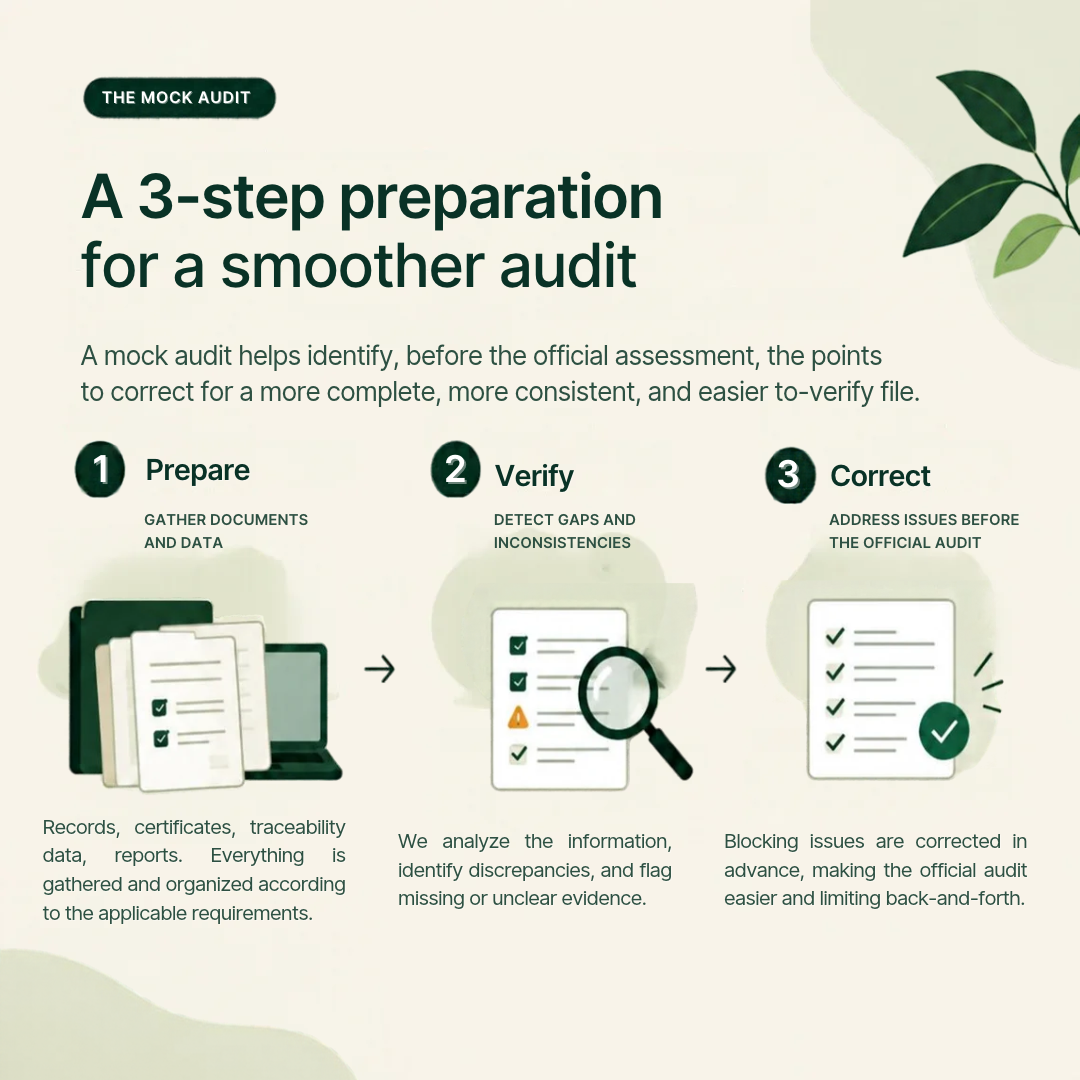
The objective is not to create a parallel certification process or replace the body authorized to conduct the audit. It is to prepare the file more thoroughly before it is submitted for assessment.
In practical terms, a mock audit can help answer five questions:
Is the required information available and up to date?
Is the data consistent across different records and documents?
Is each requirement supported by identifiable evidence?
Have discrepancies and missing items been identified?
Do teams know who is responsible for each correction and when it must be completed?
This approach makes it possible to address discrepancies before they become obstacles. It also gives teams a clearer picture of the work that remains to be done.
Understand the certification process before checking the documents
Verification cannot be limited to a simple checklist of documents.
To be useful, it must take the certification process itself into account: its different stages, applicable requirements, expected evidence, and how the information will be assessed.
Consider a cooperative participating in a certification program. A farmer list, internal records, and geolocation data may all be available. However, the mere presence of these files does not prove that all applicable requirements have been met.
The information must still be checked for consistency, the supporting documents must be assessed against the relevant requirements, and any discrepancies must be understood and addressed.
Requirements and procedures can also evolve. Rainforest Alliance, for example, publishes certification and audit rules, along with supporting documents for supply chain stakeholders. These resources highlight the importance of working with applicable requirements and their current versions rather than relying solely on established practices or outdated document templates.
A mock audit must therefore be tailored to the relevant standard, the scope of the assessment, and the organization's circumstances. A generic checklist can help structure the work, but it cannot replace an understanding of the specific requirements.
Can artificial intelligence make this preparation easier?
Manually reviewing a large number of files can be time-consuming, particularly when information is spread across spreadsheets, scanned documents, reports, and internal records.
Artificial intelligence and digital tools can help accelerate certain tasks: extracting information from documents, comparing data, identifying missing fields, flagging potential inconsistencies, or organizing evidence according to a list of requirements.
This potential extends beyond the agricultural sector. Thomson Reuters' 2025 report on generative AI in professional services highlights the use of these technologies for document review and summarization, as well as for certain audit and compliance-related tasks. The report does not measure AI's effectiveness in agricultural certification, but it illustrates the growing interest in technologies that can support document-intensive work.
For cooperatives and exporters, the challenge is to determine which tasks can be accelerated reliably. For consultants and certification bodies, it is also about dedicating more time to analysis, interpreting requirements, and supporting teams rather than performing repetitive checks that technology can partially facilitate.
This approach could help organizations better manage the time spent preparing documentation and, in some cases, reduce the need for external expertise to address straightforward documentary corrections. These benefits must nevertheless be measured: AI should not be assumed to systematically reduce audit duration or consulting costs.
One limitation remains fundamental: a tool can flag an inconsistency, but it cannot independently guarantee that a piece of data is accurate or that an organization is compliant. Its findings must be reviewed by qualified professionals. The confidentiality of farmer lists, geolocation data, and audit files must also be protected by choosing tools that meet applicable data security and usage requirements.
The objective is not to automate the auditor's judgment, but to better prepare the work on which that judgment depends.
Better audit preparation also means making better use of human expertise
A mock audit does not mean that every cooperative should stop working with consultants or develop its own tools. Specialized support remains important when requirements are complex, procedures change, or teams need training.
The question is whether certain straightforward issues can be identified and corrected before that expertise is needed.
An organization that knows which documents are missing, where data inconsistencies exist, and which pieces of evidence still need to be retrieved can have more focused discussions with its consultant and certification body. External support can then concentrate more on underlying challenges, interpreting requirements, and strengthening internal capabilities.
Getting started does not require a complex system. An organization can develop a checklist tailored to its standard, assign an owner to each requirement, schedule internal reviews, and track discrepancies until they are resolved. Digital tools can then facilitate this work according to the organization's needs and available resources.
The most important factor remains timing: these checks must take place early enough to understand the issues, correct them, and confirm that the corrections are consistent.
Conclusion: What if preparation became standard practice?
Across agricultural supply chains, compliance is not simply about having documents in a file. It also depends on data quality, consistency of evidence, and the ability to demonstrate that applicable requirements have been met.
The concept of a mock audit encourages organizations to anticipate part of the work: identifying gaps before the official assessment, improving the tracking of corrective actions, and making better use of both internal teams' and external experts' time.
Technology, particularly artificial intelligence, can contribute to this shift, provided it remains guided by the applicable standard, human judgment, and rigorous data management.
A mock audit does not guarantee a successful audit. However, it can help organizations approach the deadline with a clearer understanding of what is working, what remains incomplete, and what actions need to be taken.
Regulatory information may change over time. This content is provided for informational purposes and should not be considered legal advice.