Not All Compliance Risks Are Equal: What Should Exporters Fix First?
After a compliance review, a long list of findings can leave exporters and cooperatives wondering where to start. The answer is not to fix everything at once. It is to understand which gaps matter most, what depends on what, and how to use limited time and resources before the next deadline.
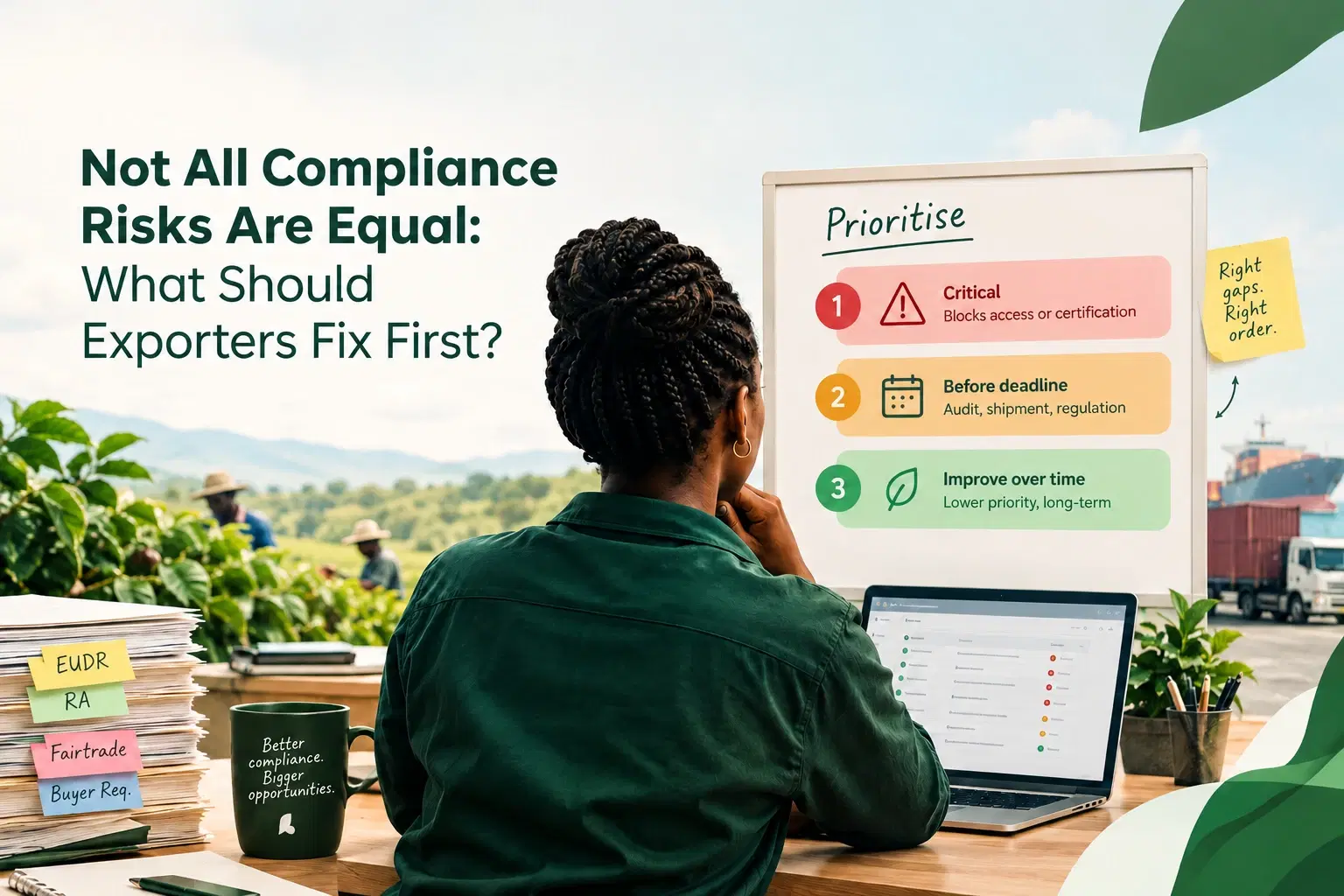
The review is done. Maybe it was a mock audit, maybe an internal check before a buyer visit. Either way, the team now has a list: a missing polygon here, an expired certificate there, a volume that does not reconcile, a farmer recorded under two spellings, a training register that was never signed.
Forty-three findings. Eight weeks before the deadline. Three people.
Everything looks urgent, so the natural instinct is to attack the list from the top, or to start with whatever is easiest. Both approaches feel productive. Both can leave the one gap that really matters untouched on the day it matters.
In our previous article, we argued that compliance preparation starts long before the auditor arrives. This one starts where that review ends: a list of gaps is not a plan. The question is what to fix first.
Severity is set by the framework, not by intuition
The first mistake is to judge a gap by how alarming it looks. A messy spreadsheet can look worse than a missing signature, yet matter far less.
How serious a gap is depends on the rules of the framework it relates to, and each framework has its own logic:
Certification standards usually distinguish what is required to obtain certification from what is expected to improve over time. Rainforest Alliance's 2020 Sustainable Agriculture Standard, for instance, separates core requirements, which must be met to be certified and are assessed on a pass/fail basis, from improvement requirements, which are progressive.
Regulations can condition market access itself. Under the EU Deforestation Regulation (EUDR), which applies from 30 December 2026 for large and medium operators and from 30 June 2027 for micro and small ones, products that cannot be supported by the required due diligence information cannot be placed on the EU market or exported from it.
Buyer requirements add their own layer through contracts and supplier codes.
So before ranking anything, link each finding to the requirement it relates to, and check how that framework treats it. This sounds obvious, but in practice many lists of gaps contain no reference to the requirement at all. A finding without its source is just an opinion.
One caution: the details of how each standard or regulation classifies issues change over time and differ between frameworks. Always check the current official documents rather than relying on habits or old templates.
The framework sets the severity. Your constraints set the order.
Two gaps can be equally serious under a standard and still deserve different places in the queue. That is where an organisation's own reality comes in. Six questions help:
Impact: what happens if this is still open on the day? Does it block a shipment, put a certification at risk, or simply make the file less tidy? A gap that can stop a lot from leaving should not wait behind cosmetic corrections.
Deadline: when does it bite? An audit date, a regulatory application date or a contractual delivery date. A serious gap due in six months may rank below a moderate gap due in three weeks.
Dependencies: what does this fix unlock? Some corrections are prerequisites for others. Under the EUDR, for example, plots above four hectares must be described with a polygon rather than a single point. Until the missing polygons are collected, no amount of work on the rest of the traceability file will close that gap. Fix the bottleneck first.
Scale: how many records does it touch? One farmer with a missing date of birth is not the same as three hundred plots without geolocation.
Effort and lead time: how long will the fix really take? Updating a register can take ten minutes. Collecting field data can require a campaign, trained staff and good weather. Long-lead items must start early, even if they are not the most severe.
Recurrence: is this a one-off, or a symptom? Ten small typos in farmer names are each minor. Together, they may reveal a data-entry process that will keep producing errors after every correction.
None of these criteria works alone. A gap that is high-impact, close to its deadline and blocking other work is an obvious priority. The harder decisions sit in between, and that is precisely why it helps to make the criteria explicit.
A simple way to sort, not a universal method
There is no single prioritisation method that fits every standard, every regulation and every organisation. But a simple structure can turn a flat list into something a team can act on.
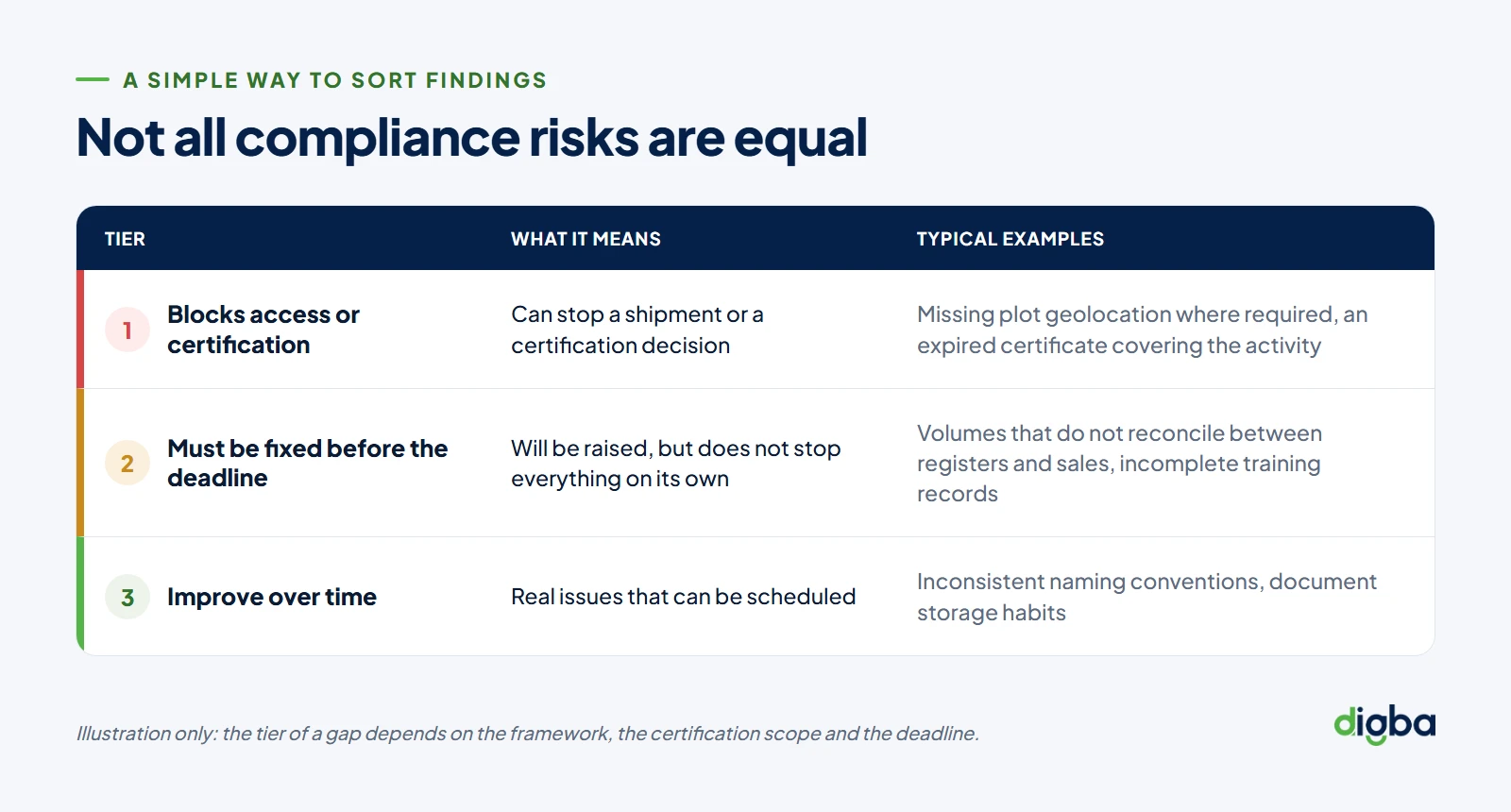
Treat this as an illustration. The examples above may sit in a different tier depending on the framework, the scope of certification and the deadline in question.
Quick wins have their place, if they know it
Easy fixes are tempting, and they are not useless. Clearing twenty small corrections in an afternoon gives a team momentum and makes the remaining file easier to read.
The risk is that quick wins quietly consume the weeks that the long-lead, high-impact work needed. A useful rule: start the slow critical items first, and fit the quick wins around them, not the other way round. Launch the field data collection on Monday, then correct the register while the teams are in the field.
And watch for patterns. When the same "small" error appears again and again, the right fix is not another correction but a change in how the data is collected or entered.
Decide what waits, and write it down
Prioritising means accepting that some gaps will not be closed before the deadline. That is not negligence, provided it is a decision rather than an accident.
For every item that is consciously postponed, record:
why it was postponed (low impact, later deadline, dependency on another fix);
who owns it;
when it will be reviewed again.
This turns "we forgot" into "we scheduled it", which is a very different conversation to have with an auditor, a buyer or a manager. It also prevents the same discussion from starting again from scratch at the next review.
Where tools help, and where they don't
Sorting dozens of findings by hand, each linked to its requirement and its documents, is slow. This is where digital tools can genuinely help: classifying findings by criticality, linking each one to the exact requirement and the documents involved, showing which issues affect the most records, and keeping the list current as corrections come in.
What tools cannot do is decide for you. Whether a gap can wait depends on context that only the team, and sometimes its consultant or certification body, can weigh: a buyer relationship, a field reality, an interpretation of a requirement. The tool should make the trade-offs visible. The people should make them.
From "how many gaps?" to "which ones matter now?"
Compliance teams in agricultural supply chains rarely lack work. What they lack is time, people and certainty that they are working on the right thing.
The number of open findings says little about how ready an organisation is. What matters is whether the gaps that can block a shipment or a certification are being handled first, whether the slow ones have started early enough, and whether everything else has an owner and a date.
The question to ask after every review is no longer "how many gaps do we have?" but "which ones matter most, right now, for this deadline?"
Regulatory information may change. This content is for information purposes only and does not constitute legal advice. Always refer to the official texts of the applicable standards and regulations.
Ready to see which compliance risks matter most in your files? DIGBA analyses your documents, links each finding to its requirement and ranks it by criticality, with the action to take.
Sources
European Union — Regulation (EU) 2023/1115 (EUDR), as amended; application dates as reported in EY Tax News, "EU Deforestation Regulation application postponed to 30 December 2026"
EUDR geolocation (polygon for plots above 4 hectares): Fairtrade, "Geolocation data requirements under the EUDR"
Rainforest Alliance, 2020 Sustainable Agriculture Standard — Farm Requirements and certification documents
Regulatory information may change over time. This content is provided for informational purposes and should not be considered legal advice.